


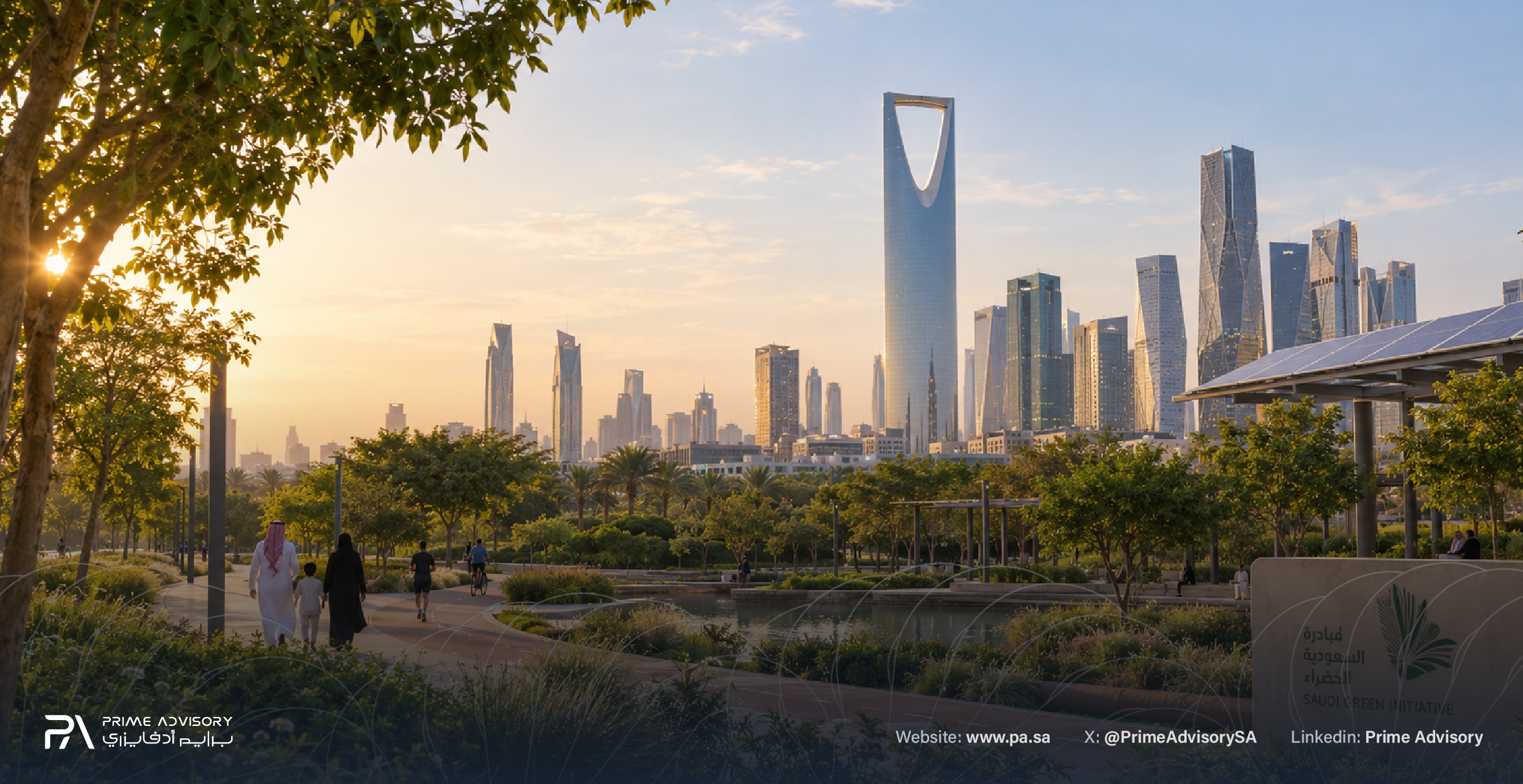
The Saudi green initiative has taken a surprising turn especially in Riyadh where we now have 4,000 parks representing 19 km2 of greenery, 10 million trees, and 7,600 km of planted roads. Now if you don’t yet understand the breadth of these numbers, you may want to know that the Saudi green initiative is leading the region in 2026 since the Kingdom has 2,000 out of the 5,000 green buildings underway in the Middle East.
The market prospects are showing a brighter future at 12.3% CAGR to push the revenue to 33 billion by 2030. As an initiative in the real estate sector, the aim of the green project is to improve the quality of life, enhance wellbeing and safety and contribute to economic value creation.
In this article, we look at the green initiative and how it’s defining the real estate sector in Saudi Arabia
Saudi Green Initiative Leading the Region in 2026
Saudi Arabia is moving fast on green action. The Saudi Green Initiative (SGI) has become the kingdom’s central climate platform. It ties urban greening, large-scale afforestation, emissions cuts and clean-energy investment into a single national push. The result is visible progress in Riyadh and across the country. This progress now positions Saudi Arabia as a regional leader in 2026.
Progress on the ground: Riyadh goes green
Riyadh’s urban transformation is the most tangible sign of the SGI at work. The Green Riyadh programme aims to plant 7.5 million trees across the capital. It will increase green cover, cool streets and create public parks and corridors. The plan also includes a 1,350 km treated-water irrigation network to support large-scale planting and protect potable supplies. These measures are already changing the city’s fabric and improving livability.
Beyond Riyadh, the SGI reports rapid afforestation and land rehabilitation. By mid-2025 the kingdom announced more than 151 million trees planted and half a million hectares rehabilitated under national programs. That is a major step toward the SGI’s longer-term 10-billion-tree ambition.
Energy transition: big bets on renewables and storage
Saudi Arabia is pairing green landscape work with heavy investment in clean power. New solar and wind capacity is being awarded and connected at scale. Recent projects added several gigawatts to the grid and pipeline announcements promise further rapid growth. The kingdom is directing billions into renewables, storage and green hydrogen enabling infrastructure. Those investments aim to both decarbonize domestic power and protect export revenues by freeing up crude formerly used for power generation.
How Saudi compares with neighbors
The Gulf is active in climate. The UAE leads in corporate sustainability profiles and early hydrogen strategies. Qatar and Jordan are advancing renewables and carbon management. But Saudi’s advantage in 2026 is scale and integration. It combines national afforestation, urban delivery (Riyadh), and large renewables pipelines with direct public finance via institutions such as the PIF. The SGI’s portfolio, 85+ initiatives spanning land, marine and emissions, gives the kingdom a broad toolbox that few neighbors match in scope today.
Prospects: why momentum could continue
Saudi Arabia has three strengths that sustain momentum. First, clear political backing at the highest level. Second, large public finance capacity to underwrite risky, long-horizon projects. Third, integrated planning that links water, urban design and power. Together these reduce the chance that projects stall. If implementation keeps pace, Riyadh’s greening will deliver measurable cooling, better air quality and new public amenities. The renewables push will lower domestic emissions intensity and create exportable green industries.
Risks and caveats
Delivery is not guaranteed. Afforestation in arid zones depends on sustainable water management and long-term tree survival. Renewables require grid upgrades and storage to be reliable. There is also reputational risk: environmental credibility depends on transparent reporting and independent verification. Finally, social outcomes matter. Green projects must be inclusive and benefit everyday residents to sustain political support.
In sum…
By combining ambitious urban greening in Riyadh, rapid afforestation nationwide and a major renewable build-out, Saudi Arabia has moved from promise to measurable progress. In 2026 the Saudi Green Initiative is not only a slogan. It is an active program with large-scale results. The next test is durability: keeping projects funded, well managed and transparent. If Saudi does that, the kingdom will remain the region’s standard-bearer for integrated climate action.